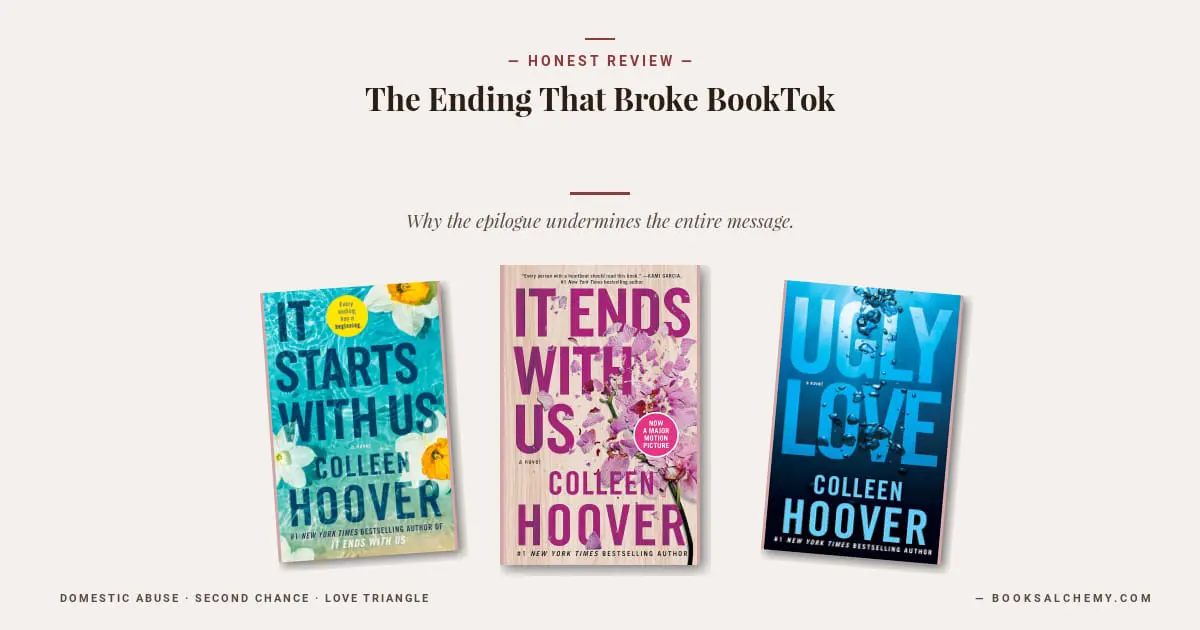
The Book It Ends With Us: An Honest Review & Series Guide
Here’s the thing about how the book It Ends with Us was sold on BookTok: it wasn’t sold honestly. The aesthetic edits, the “slow-burn romance” captions, the swoony Ryle fan cams — none of that prepared readers for what the book is. If you’re here because you saw the movie trailer or watched a hundred TikToks and want to know what you’re getting into, this is the review that will tell you.
The book It Ends with Us is a contemporary fiction novel about domestic abuse, disguised in the early chapters as a romance. That’s not a criticism — it’s the point. Colleen Hoover uses the conventions of the romance genre deliberately, pulling readers into the same psychological trap her protagonist falls into.
The story follows Lily Bloom, a woman in her mid-twenties who moves to Boston after her father’s funeral and starts building the life she always wanted: her own flower shop, a new city, and a new relationship with a neurosurgeon named Ryle Kincaid. Ryle is confident, charming, and intensely focused on Lily. Early chapters read like a standard contemporary romance — rooftop conversations, slow-burn tension, a man who seems almost too perfect.
But Hoover is doing something more complicated than a love story. Lily’s past keeps surfacing through journal entries she wrote as a teenager, describing her first love — a boy named Atlas Corrigan — and the difficult circumstances that brought them together. Those flashbacks do more than add backstory. They establish a baseline for what Lily has always known about love, survival, and the choices people make when they’re trapped.
The genre debate around this book is real. Goodreads lists it under romance, but that categorization is misleading enough that it’s worth addressing directly before you buy it.
Book Title
Author
Genre Reality
Spice Level
It Ends with Us
Colleen Hoover
Contemporary Fiction / Domestic Abuse Narrative
3/5
Readers who go in expecting a swoony Colleen Hoover romance — the kind that’s heavy on tension and light on consequence — often come out shaken in ways they didn’t anticipate. The book earns its 4.07 Goodreads rating across nearly five million ratings, but the reviews are sharply divided, and that division tells you something. This isn’t a book that leaves everyone feeling the same way. It’s supposed to make you uncomfortable. Whether it does that effectively, or whether the execution has real flaws, is something we’ll get into.
The True Story Behind the Trauma
Colleen Hoover has spoken publicly about the fact that It Ends with Us is directly inspired by her mother’s experience with domestic abuse. Her mother was in an abusive relationship and eventually left — a decision that Hoover has described as one of the most difficult and brave things she ever witnessed. The book is, in many ways, her attempt to process and honor that experience.
This context matters for how you read the novel. Hoover isn’t writing domestic abuse from the outside as a plot device. The emotional accuracy in the early sections — the way Ryle’s behavior escalates gradually, the way Lily rationalizes what’s happening, the way love and fear become difficult to separate — comes from a place of real, inherited understanding. That’s why the portrayal of a charming abuser lands as effectively as it does for so many readers. It doesn’t feel like a villain origin story. It feels like something that could happen to someone you know. Because it did happen to someone Hoover loves.
Hoover dedicated the book to her father, who she has described as someone who broke the cycle in his own family. The title itself — It Ends with Us — refers to the idea of being the person in a family line who decides the pattern of abuse stops here. That’s not a romantic sentiment. It’s a generational one. Understanding that before you open the book reframes the entire reading experience.
Some readers feel this backstory gives the novel an emotional weight that elevates it beyond typical fiction. Others feel that the personal connection makes certain narrative choices — particularly in the ending — harder to defend when they don’t fully align with what the research and survivor advocacy communities recommend. That tension is worth keeping in mind.
Spice Level, Content Warnings, and The Reading Experience
The question ‘is the book it ends with us spicy’ comes up constantly, and the honest answer is: somewhat, but that’s not what the narrative is about. The spice level sits at roughly 3 out of 5. There are explicit scenes, particularly in the early-to-mid sections when Lily and Ryle’s relationship is developing. The physical intimacy is written directly, not faded-to-black, but it’s not the focus of the narrative the way it would be in a CoHo book like Ugly Love. If you’re coming to this specifically for high-spice content, you’ll find some — and then the story will shift under you in a way that makes the earlier scenes feel very different in retrospect.
What the book is primarily about is emotional and physical abuse, and the content warnings here are not minor.
Trigger Warning Category
Severity
Context (Spoiler-Free)
Domestic Violence (Physical)
High
Occurs multiple times; depicted with clear cause-and-effect, not gratuitously but not softened
Emotional Abuse & Manipulation
High
Central to the relationship dynamic; includes gaslighting and minimizing
Sexual Assault / Attempted Rape
High
One incident involving a main character; not described graphically but is unambiguous
Child Abuse (Referenced)
Moderate
Part of Lily’s backstory via journal entries; not depicted in real-time
Infant / Child Welfare
Moderate
Becomes relevant in the final third; emotionally heavy
Suicide (Mentioned)
Low
Brief reference; not a central plot point
The pacing of the book is worth discussing honestly. The first half moves quickly — Hoover is good at building romantic tension, and the journal flashbacks to teenage Lily and Atlas are some of the most quietly effective writing in the novel. The second half is where readers tend to either commit fully or start to feel the weight become difficult to carry. The escalation of Ryle’s behavior is handled gradually enough that some readers report not fully registering what they were reading until they were already deep in it. That’s intentional, and it’s also the source of significant discomfort for readers who’ve experienced similar situations in real life.
This is not a book to read when you’re in a fragile headspace. It’s also not a book to dismiss because of the heavy themes. Those are two different statements, and both are true.
The Complete It Ends With Us Series in Order
The series consists of exactly two books. There is no It Ends with Us book 3 — that search query circulates because readers want more of Lily’s story, but Hoover has not written a third installment and has not announced one as of this writing.
The reading order is:
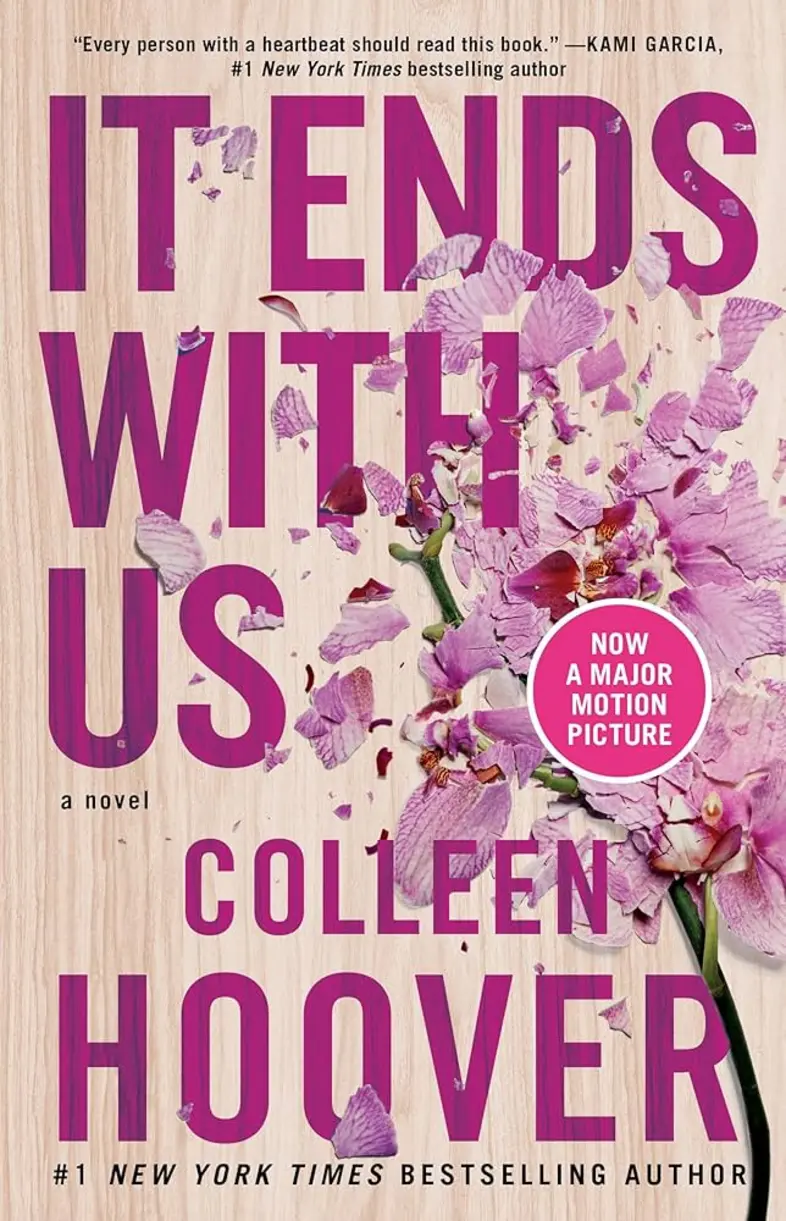
It Ends with Us (2016) — Book 1 of 2 — Spice Level: 3/5
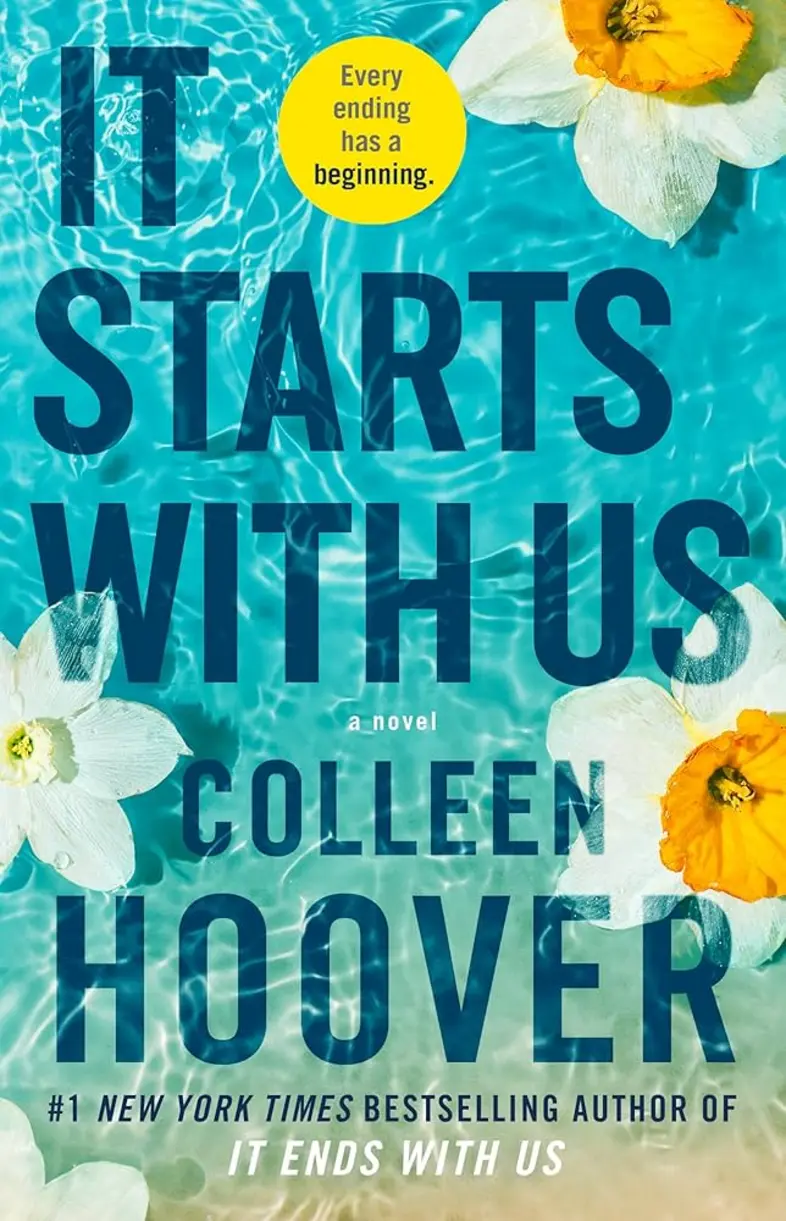
It Starts with Us (2022) — Book 2 of 2 — Spice Level: 3/5
Setup: This is the foundational book — the one you must read first, and the one that carries the full emotional weight of the series.
As it ends with us book 1, this is non-negotiable as your starting point. Everything in the sequel depends on where this book leaves Lily, and reading them out of order would strip the second book of all its emotional context. The 367 pages move through Lily’s relationship with Ryle from its beginning to a conclusion that will either feel earned or deeply complicated depending on how you read the final chapters. Don’t start with the sequel. Don’t skip this one because the themes are heavy. The series only works if you do the work of book one first.
Setup: Written six years after the first book in response to reader demand, It Starts with Us picks up Lily’s story and gives her the lighter, forward-moving narrative that book one couldn’t provide.
As it ends with us book 2, this is the sequel that answers the question book one leaves hanging. Is it necessary? That depends on what you want. If you finished book one and felt the ending was too unresolved — if you needed to see Lily building the life she chose — then yes, read it. The dual POV structure (Lily and Atlas narrating alternately) makes it feel distinct from the first book, and the Goodreads rating of 3.84 reflects that many readers found it lighter and less emotionally complex than they wanted. It’s not a bad book. It’s a softer book, and for some readers that’s exactly what they need after the weight of book one. For others, the tonal shift feels like a letdown. Reading it ends with us series in order gives you the complete arc — but if you finished book one feeling satisfied, you won’t be lost without the sequel.
Spoiler Warning: Why Did Lily Divorce Ryle?
⚠️ MAJOR SPOILERS BELOW ⚠️
This section contains full plot spoilers for It Ends with Us. If you haven’t finished the book and don’t want the ending revealed, stop reading here and scroll to the Final Verdict section.
Scroll past this section if you haven’t finished the book.
Last warning.
Lily divorces Ryle because she discovers she is pregnant and recognizes, with absolute clarity, that she cannot raise a child inside a cycle of abuse she has already witnessed destroy a family — her own.
The incidents of Ryle’s violence escalate throughout the second half of the novel. What begins as something Lily tells herself was an accident — a shove, a moment of lost control — becomes undeniable when the pattern repeats. Hoover structures this escalation carefully. Each incident is followed by Ryle’s remorse, his explanations, his love for Lily that is genuine and also completely compatible with his violence. That’s the uncomfortable truth the book is trying to tell: abusers are not always monsters. They are often people who love their partners and also hurt them, and the love doesn’t cancel the harm.
The specific breaking point is not a single dramatic confrontation. It’s a moment of recognition. Lily grew up watching her mother stay with a man who hurt her. She wrote about it in those teenage journal entries. She understood, even as a child, what her mother was enduring — and she watched her mother make the choice to stay. When Lily realizes she’s pregnant and looks at the pattern of her own relationship, the decision she makes is the one her mother couldn’t. That’s where the title lands its full weight. It ends with her. She is the person in her family line who stops it.
The divorce is not impulsive. It’s the result of Lily finally applying to her own life the framework she’s held her whole life: that staying is a choice, leaving is a choice, and she gets to make a different one than the women before her.
Where the book gets complicated — and where reader discussions remain sharply divided years after publication — is the epilogue. After finishing the book, I found myself stuck on two specific choices Hoover makes in the final pages. The first is the co-parenting arrangement, which grants Ryle unsupervised visitation with their daughter. For a book that has spent 350 pages carefully documenting a pattern of escalating violence, allowing a man with that history unrestricted access to an infant feels like it undercuts the very message the book has been building toward. Survivor advocacy organizations consistently recommend supervised visitation in cases of documented domestic violence, and the epilogue’s logistics don’t reflect that reality.
The second issue is the speed of Lily’s reunion with Atlas. Reader discussions are split here — some feel the immediate pivot to Atlas undermines Lily’s journey toward self-reliance, while others are less bothered by the romance and more focused on the co-parenting arrangement being unsafe by any realistic standard. For me, both issues compound each other. The practical inconsistencies in those final chapters do real damage to the emotional weight Hoover built so carefully in the preceding pages. The message of breaking the cycle deserved an ending that took its own logic seriously all the way through.
Setup: A contemporary fiction novel that uses romance conventions to tell a story about the psychology of abusive relationships and the difficulty of leaving.
Read this if you can handle heavy themes and want a book that takes domestic abuse seriously as a subject — not as a backdrop, but as the entire point. The first 75% is effective. Hoover’s portrayal of how a relationship with a charming, high-functioning abuser develops is uncomfortable in the way it’s supposed to be. You understand why Lily stays. You understand why leaving is complicated. The book earns those pages.
Go in knowing the epilogue will divide you. The ending has real structural problems that critical readers will notice, and pretending otherwise would be dishonest. But those problems don’t erase what the book does well in the majority of its pages.
Don’t read this if you’re in a vulnerable place regarding relationship trauma. The content is handled with more care than many books that tackle similar themes, but it’s still heavy, and you know your own limits better than any review does.
The movie adaptation (2024, starring Blake Lively and Justin Baldoni) is worth watching as a companion experience, though the film’s own marketing controversies ended up mirroring the book’s — sold as a romance, received as something far more complicated.
Trigger Warnings: Infant loss, death of a parent, grief, car accident, graphic sexual content, emotional abuse
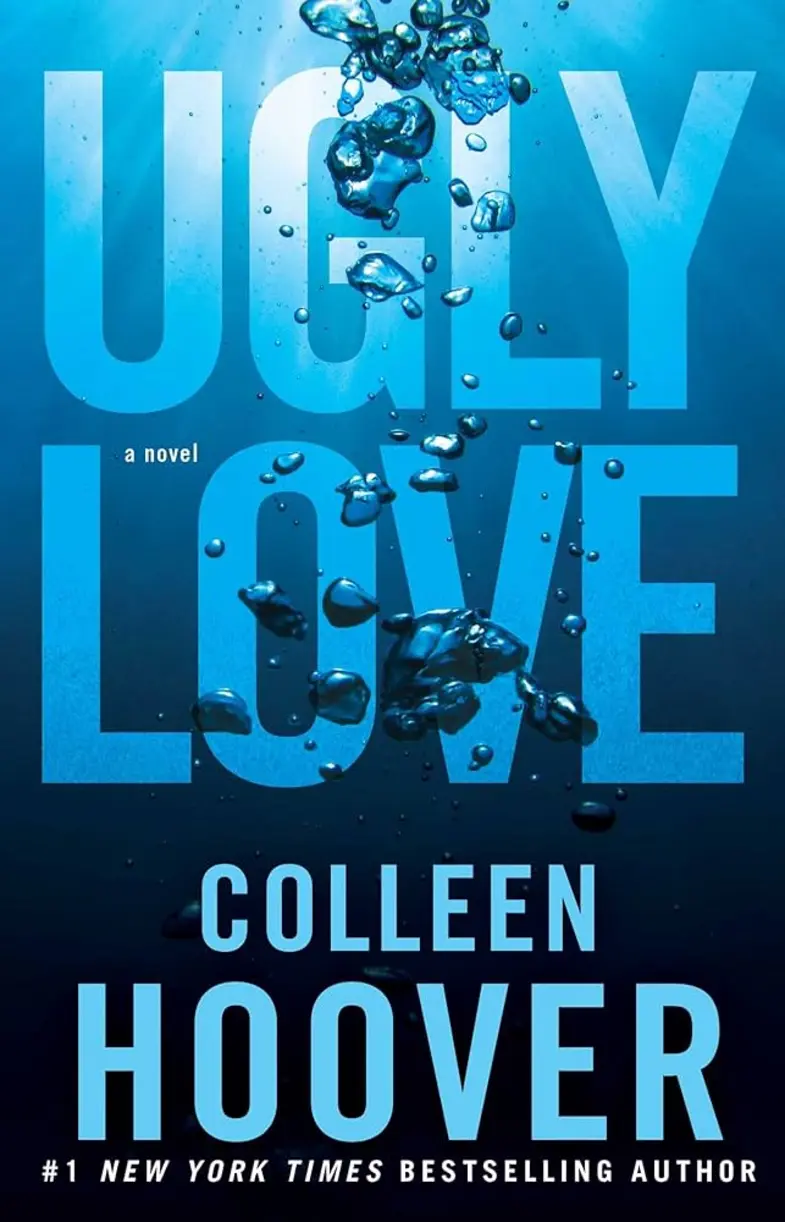
Setup: If you came to It Ends with Us specifically for a high-spice Colleen Hoover romance and found the heavy themes more than you bargained for, this is the book you were looking for.
Ugly Love is the CoHo book that delivers on the spice-heavy promise that It Ends with Us doesn’t. At 5/5 spice, it’s a different reading experience entirely — the emotional weight here comes from grief and emotional unavailability rather than domestic violence, and while it has its own content warnings, it’s not in the same category of heavy. If you want to understand why Colleen Hoover built such a massive readership, Ugly Love shows you the other side of what she does.
Frequently Asked Questions
What is the book It Ends with Us about?
It Ends with Us is a contemporary fiction novel about a young woman named Lily Bloom who falls into a relationship with a charming neurosurgeon named Ryle Kincaid. Despite being marketed as a romance, the book is primarily about domestic abuse — specifically, the psychological complexity of loving someone who hurts you, and the difficulty of leaving. It draws heavily on author Colleen Hoover’s mother’s real experience.
Is It Ends with Us based on a true story?
Not directly, but it’s closely inspired by real events. Colleen Hoover has confirmed that the book was inspired by her mother’s experience in an abusive relationship and her eventual decision to leave. The emotional dynamics in the novel reflect that personal history. The characters and specific plot events are fictional, but the psychological and emotional core of the story comes from Hoover’s own family.
Is the book It Ends with Us spicy?
It has explicit content — roughly a 3 out of 5 on spice — but that’s not its primary focus. The intimate scenes are written directly and occur mainly in the first half of the book. The second half shifts significantly into darker, heavier territory. Readers looking specifically for high-spice content will find more of it in other Colleen Hoover titles like Ugly Love, which sits at 5/5.
Do I need to read It Starts with Us after It Ends with Us?
You don’t need to, but it depends on what you want from the story. It Ends with Us has a complete arc on its own. It Starts with Us provides a lighter, forward-moving continuation of Lily’s life and answers questions about her relationship with Atlas. If the ending of book one left you wanting resolution, read the sequel. If you felt the first book was complete, you won’t be lost without it.
Is there an It Ends with Us book 3?
No. The series consists of two books: It Ends with Us (2016) and It Starts with Us (2022). Colleen Hoover has not announced a third book in the series. The search query circulates because readers want more of Lily’s story, but as of now, no third installment exists.
Leave a Review and Help Other Book Lovers Decide
0
0 out of 5 stars (based on 0 reviews)
Excellent
Very good
Average
Poor
Terrible
There are no reviews yet. Be the first one to write one.